Nantucket Short Term Rental

Public Affairs and Communications Plan

the

OVERVIEW

In early 2021, Pierce-Coté / Regan Communications was retained by a major owner of short-term rental properties on Nantucket to support a public affairs and communications initiative related to a proposed Town Meeting warrant article that would have significantly restricted short-term rentals on the island.

Given Nantucket’s reliance on tourism and seasonal visitation, the proposed restrictions had the potential to affect local businesses, employment, municipal revenues, and the broader island economy. Pierce-Coté / Regan Communications developed and executed a comprehensive public relations, stakeholder engagement, and marketing campaign designed to educate voters regarding the potential economic impacts of the proposal.

the

CHALLENGE

The client’s business supported numerous island residents and local service providers, including real estate professionals, landscapers, caretakers, contractors, and hospitality workers. The proposed restrictions generated significant concern among stakeholders who believed the measure could negatively affect employment opportunities and economic activity throughout the community.

A key challenge was ensuring that public opposition to the warrant article was viewed as a broad community concern rather than as the position of a single property owner. The communications strategy therefore required the rapid development of a credible coalition and an effective voter education campaign.

the

STRATEGY AND EXECUTION

Pierce-Coté / Regan Communications established and managed the Alliance to Protect Nantucket’s Economy, a coalition of residents, businesses, and community stakeholders committed to educating voters about the potential consequences of the proposed regulations.

Key elements of the campaign included:

  • Development of coalition branding, messaging, website content, and social media platforms.
  • Community outreach and stakeholder engagement initiatives.
  • Presentations to civic organizations and community groups.
  • Strategic media relations, including opinion pieces, letters to the editor, spokesperson coordination, and rapid-response communications.
  • Ongoing monitoring and correction of inaccurate or misleading information related to the proposed warrant article.


To provide an objective assessment of the potential economic impacts, Pierce-Coté / Regan Communications coordinated an independent economic impact study conducted by the UMass Donahue Institute. The study projected that the proposed restrictions would substantially reduce the availability of short-term rental accommodations, decrease annual visitation, and negatively affect local employment, wages, and tax revenues.

Pierce-Coté / Regan Communications leveraged the study findings through an integrated communications campaign that generated extensive local, regional, and national media coverage, including a feature article in The Wall Street Journal. The public relations effort was further supported by a targeted direct-mail program, digital advertising, and paid media placements.

the

RESULTS

In June 2021, Nantucket Town Meeting voters rejected the proposed warrant article.

The issue remained active through multiple subsequent Town Meeting cycles, requiring sustained public engagement, strategic communications, and stakeholder outreach. Pierce-Coté / Regan Communications continued to refine messaging, support coalition activities, and educate voters regarding the economic implications of proposed zoning and short-term rental restrictions.

In 2025, Nantucket voters approved a measure that broadly legalized short-term rentals across the island, bringing greater regulatory certainty to residents, property owners, and local businesses.

This engagement demonstrates Pierce-Coté / Regan Communications’ ability to manage complex public affairs campaigns, build stakeholder coalitions, coordinate third-party research, and execute long-term communications strategies involving highly visible and controversial public policy issues.

Direct mail

Six pieces, three town meetings

Every registered voter on the island received mail ahead of each Town Meeting. The creative tightened as the fight went on — from mood photography and general talking points in 2021, to ballot-specific wayfinding in 2022, to hard numbers from an independent UMass study in 2024.

2021 Article 90  ·  Town Meeting June 5

First cycle. The ask was simple — vote no — so the fronts carried the emotional argument and the backs kept to three plain-language reasons plus voter-registration logistics.

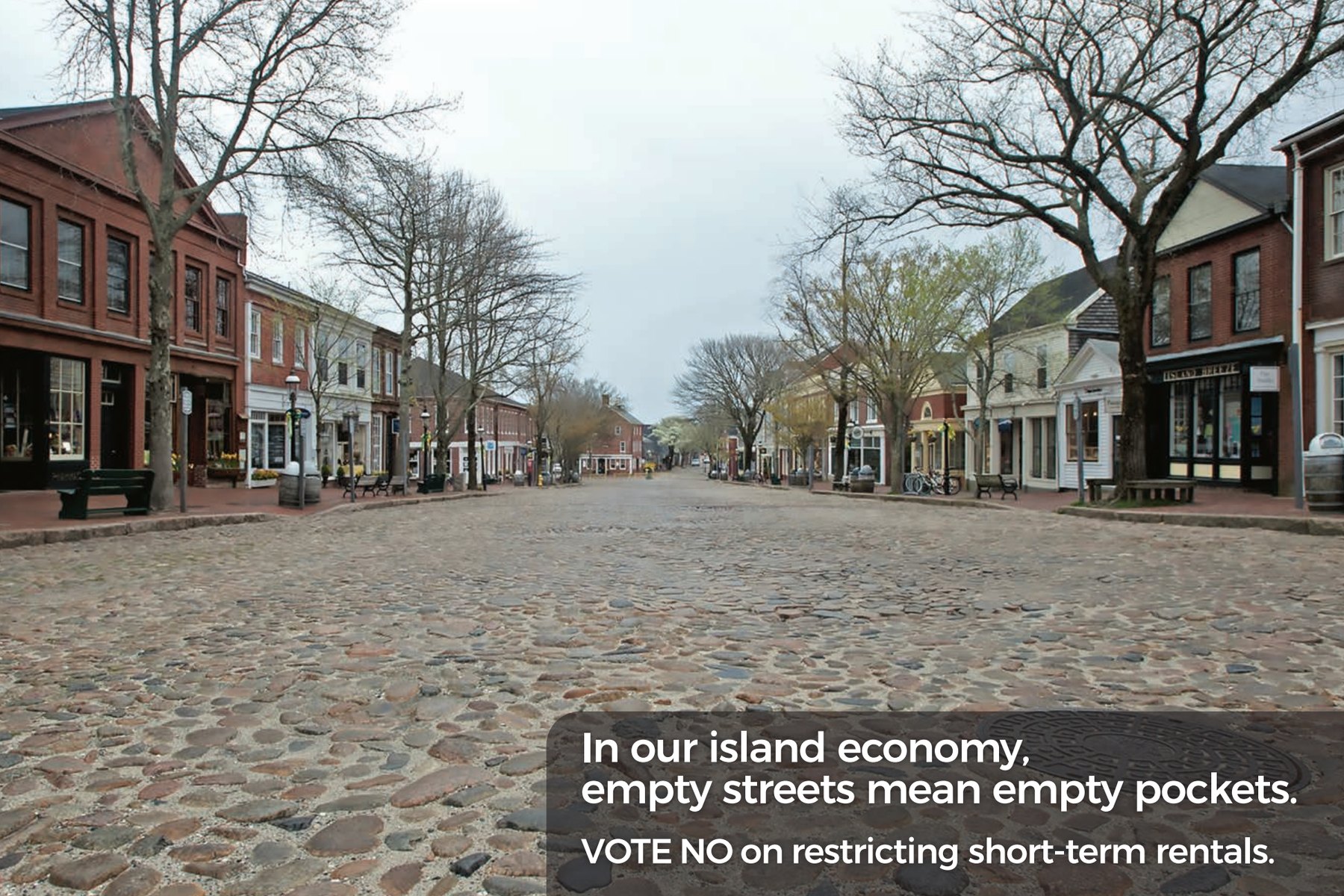
  • Mailer front: empty cobblestone Main Street in Nantucket with the headline "In our island economy, empty streets mean empty pockets."
    Front Empty streets Off-season Main Street, shot down the cobblestones. “Empty streets mean empty pockets.”
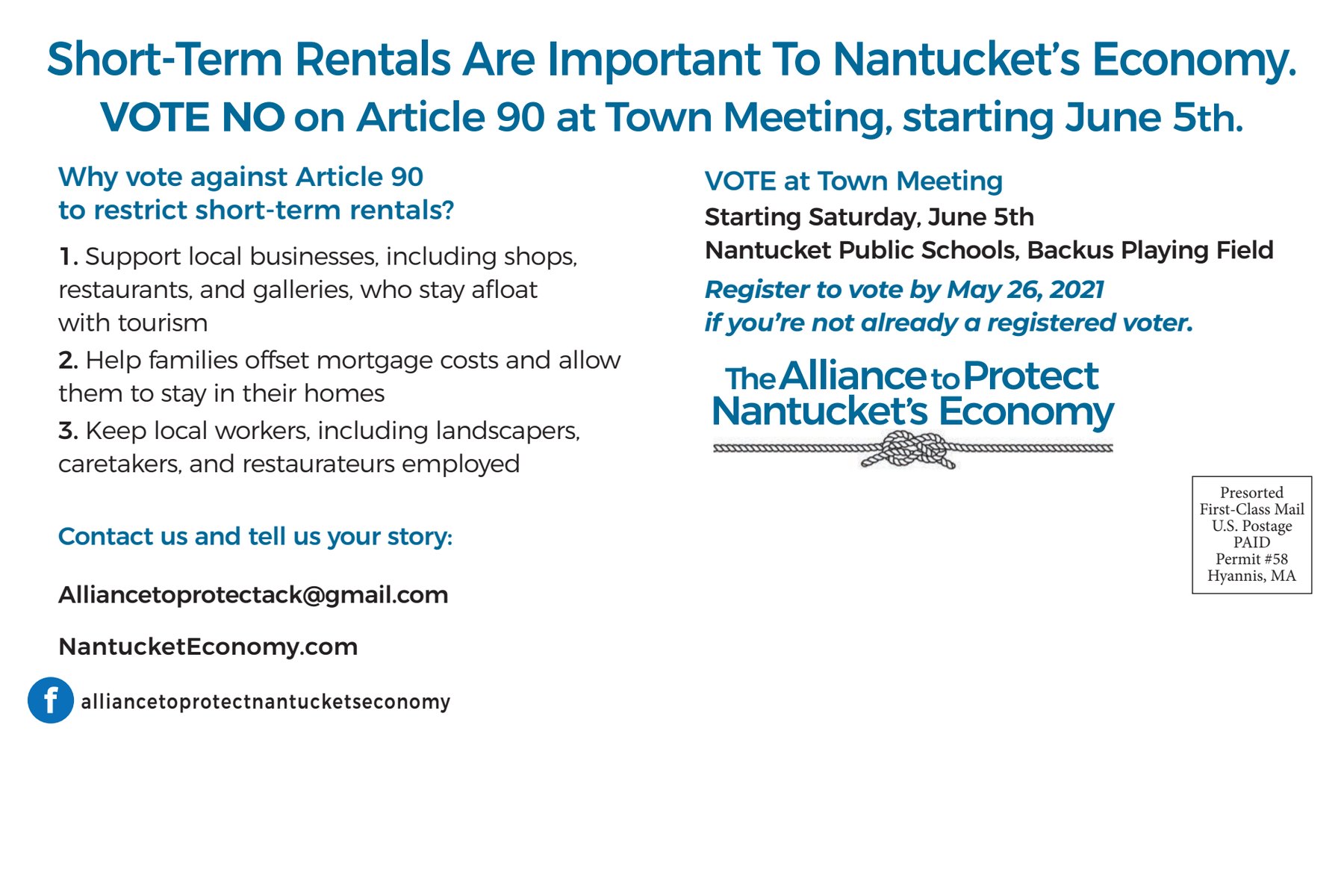
  • Mailer back: three reasons to vote against Article 90, Town Meeting details, and Alliance contact information.
    Back Three reasons Local business, mortgage relief, and island jobs — plus the May 26 registration deadline.
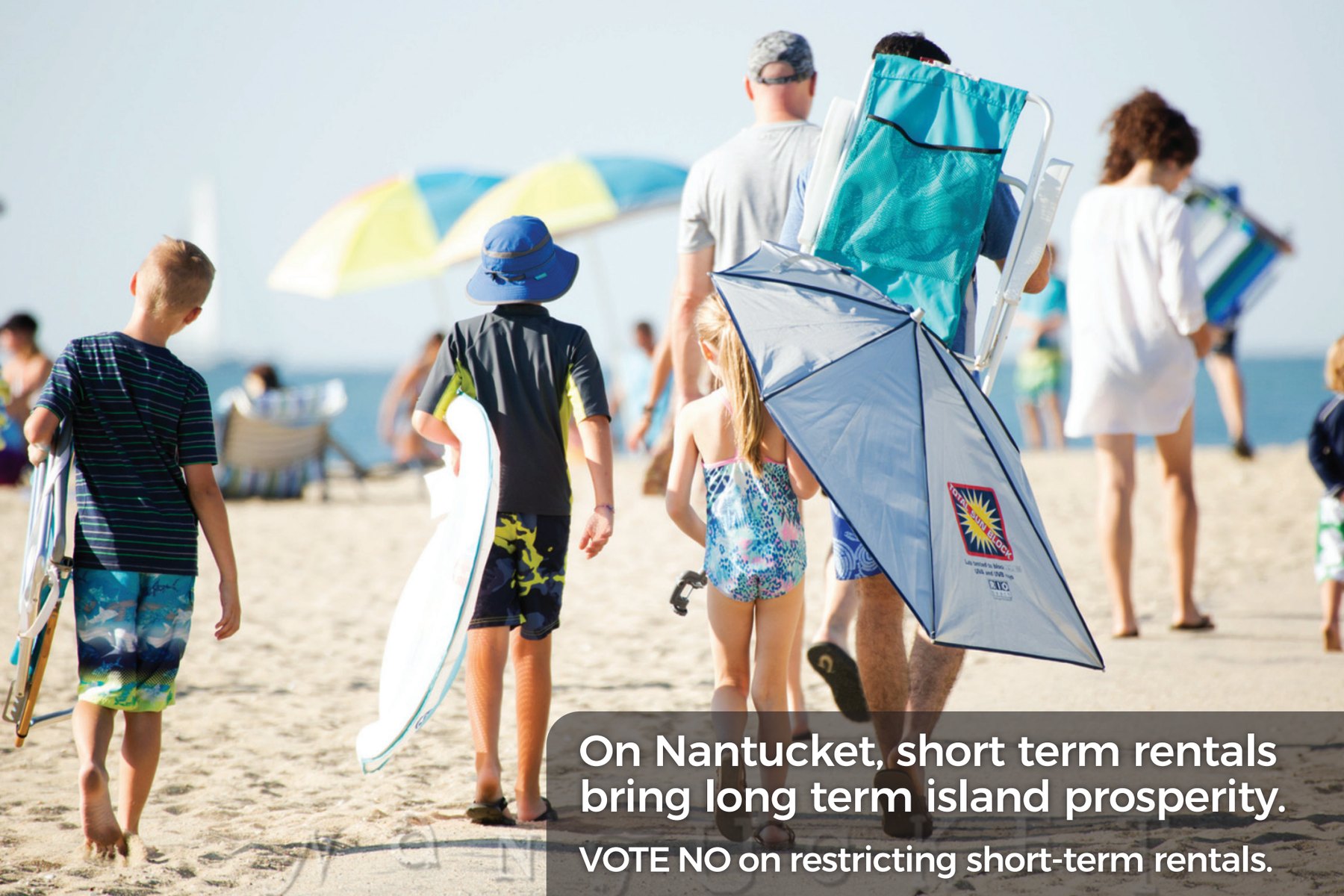
  • Mailer front: a family carrying beach chairs and umbrellas across the sand, with the headline about short term rentals bringing long term island prosperity.
    Front Long term prosperity Visiting family heading to the beach — the tourism economy as people, not statistics.
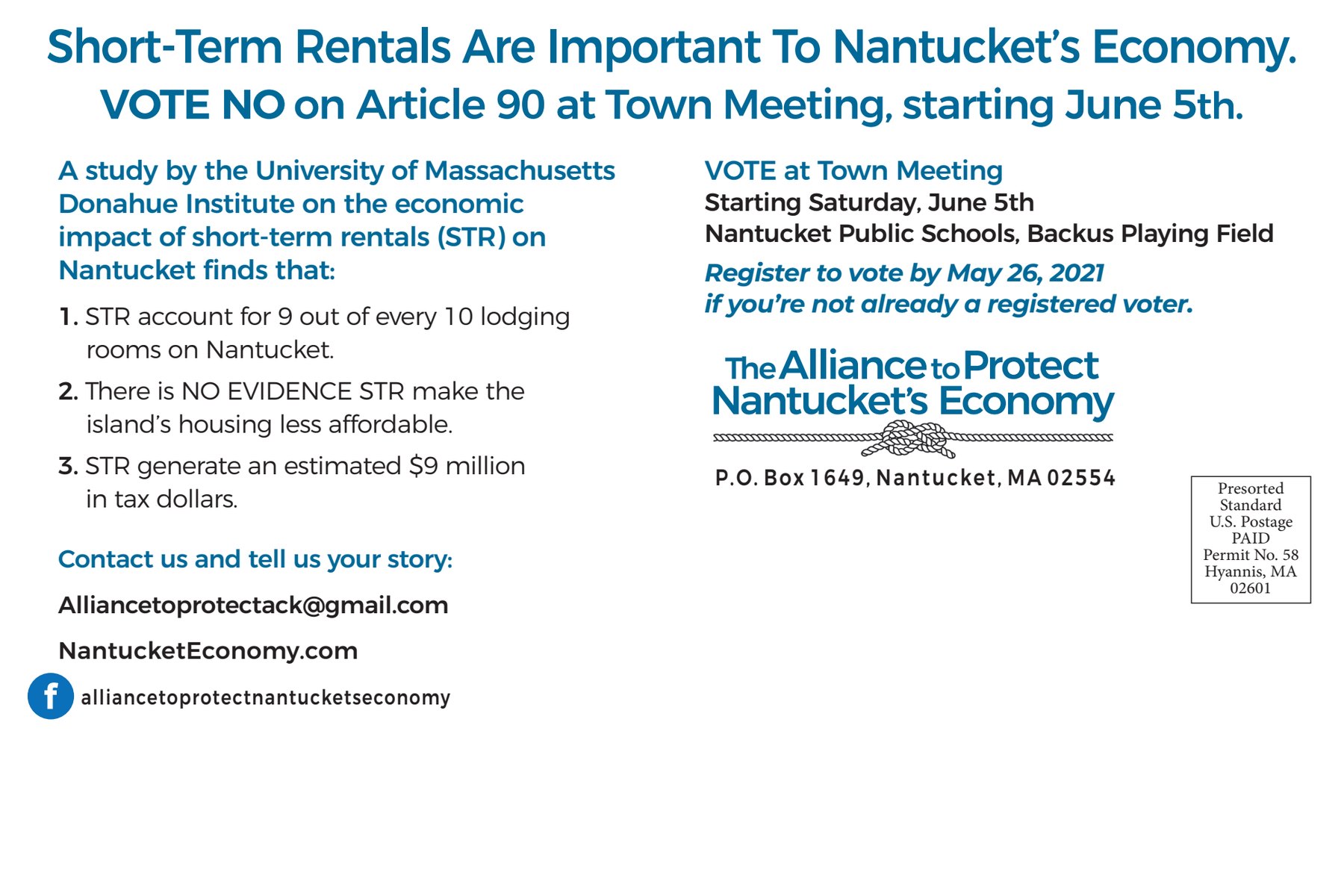
  • Mailer back: findings from a UMass Donahue Institute study on the economic impact of short-term rentals on Nantucket.
    Back The study, introduced First use of UMass Donahue data: 9 of every 10 lodging rooms, $9M in tax dollars.
2022 Articles 39, 42 & 43  ·  Town Meeting May 2

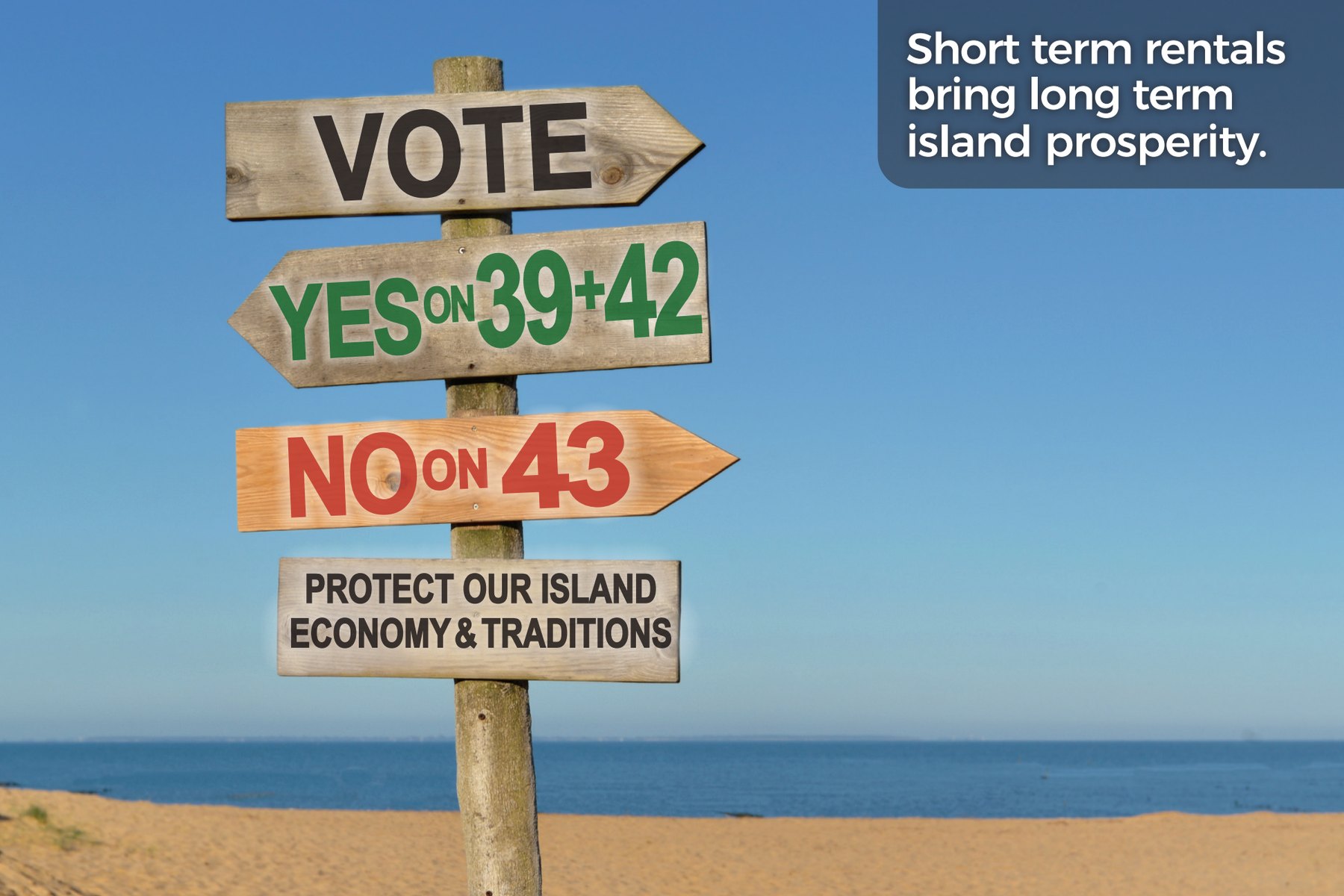
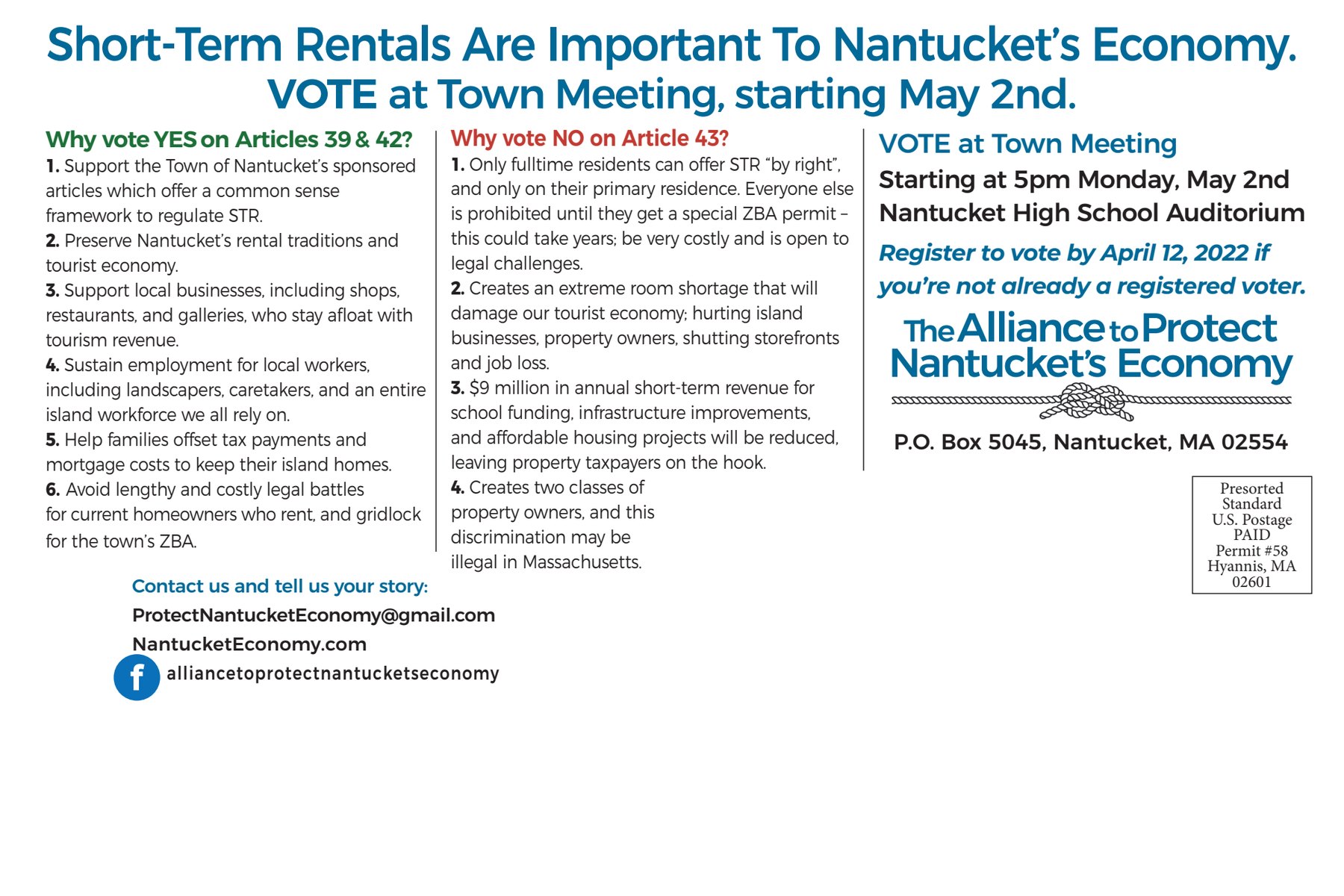
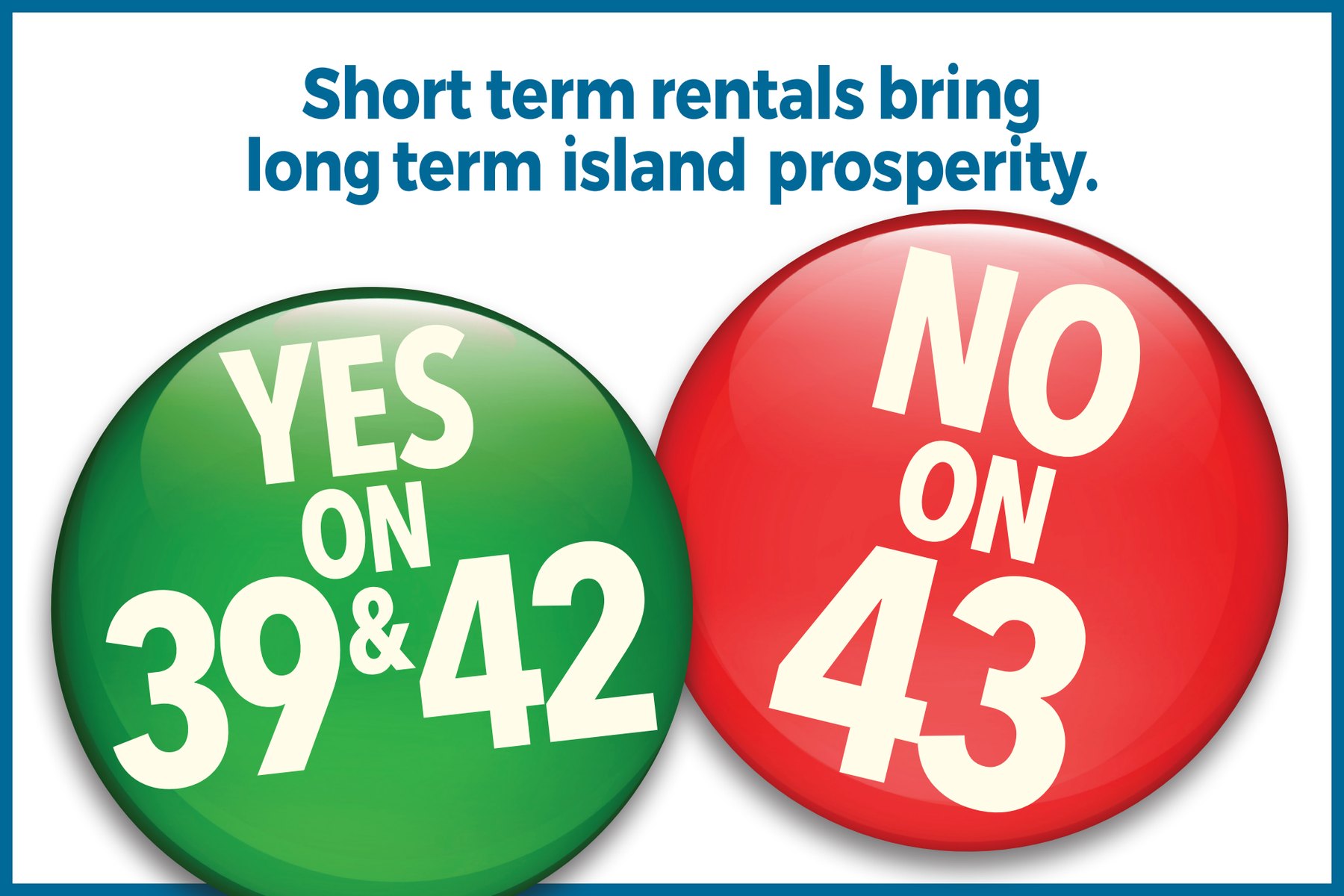
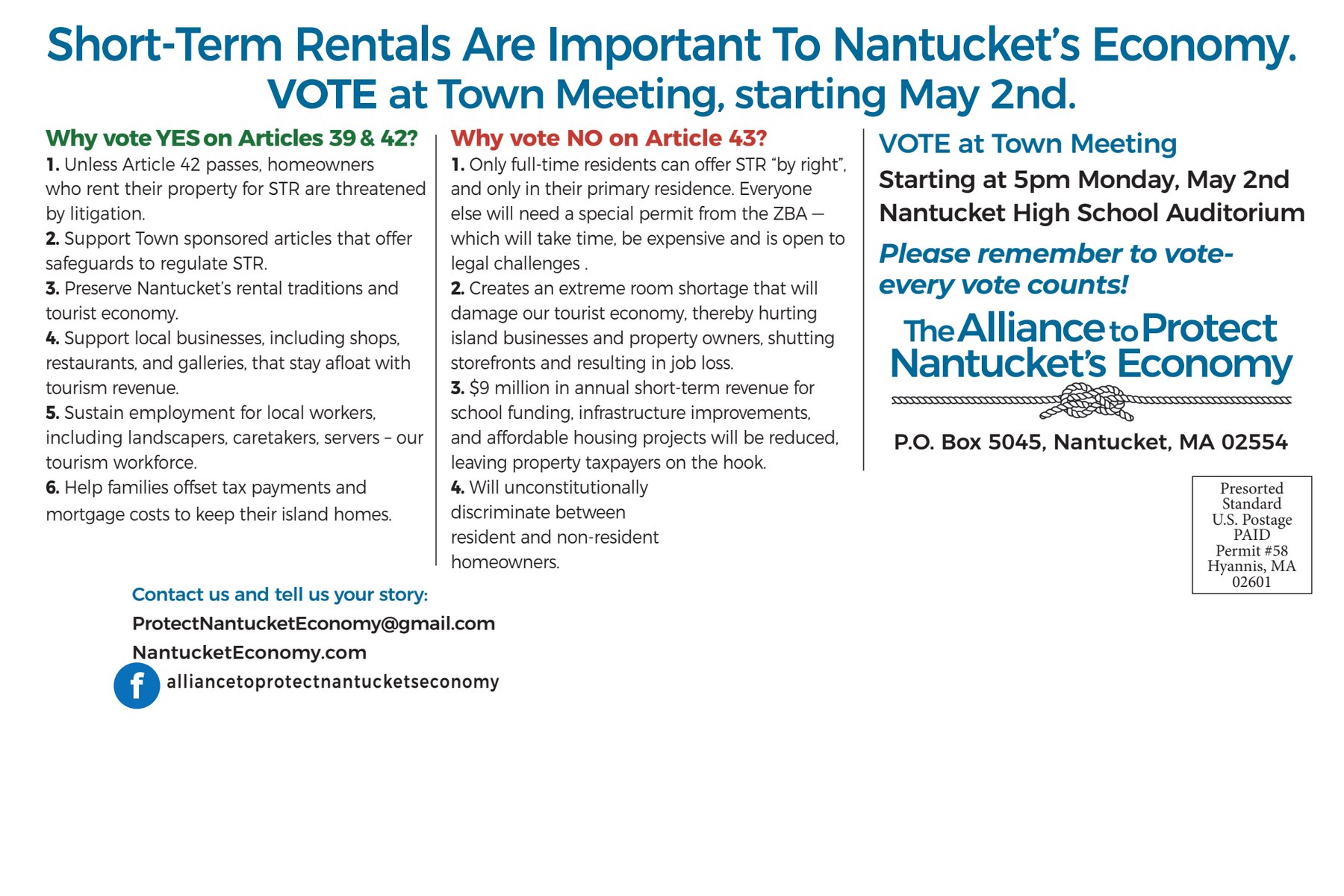
A harder ask: three articles, two different votes. The creative problem was making a split ballot memorable, so both fronts became wayfinding devices — a signpost and a pair of voting buttons — and the backs ran YES and NO reasoning in parallel columns.

  • Mailer front: a wooden beach signpost reading VOTE, YES on 39+42, NO on 43, Protect Our Island Economy and Traditions.
    Front The signpost Beach signpost stacking all three votes in ballot order — directions, not argument.
  • Mailer back: parallel columns explaining why to vote yes on Articles 39 and 42 and no on Article 43.
    Back Split ballot, split columns Six reasons for YES, four against Article 43, with the ZBA permit burden front and center.
  • Mailer front: large green YES on 39 and 42 button beside a red NO on 43 button.
    Front Green and red Campaign-button treatment reducing the whole ballot to two glanceable shapes.
  • Mailer back: revised yes and no reasoning columns, leading with the litigation threat to homeowners.
    Back Revised, sharper Second pass leads with litigation risk to homeowners and drops the softer opener.
2024 Article 60  ·  Town Meeting May 6

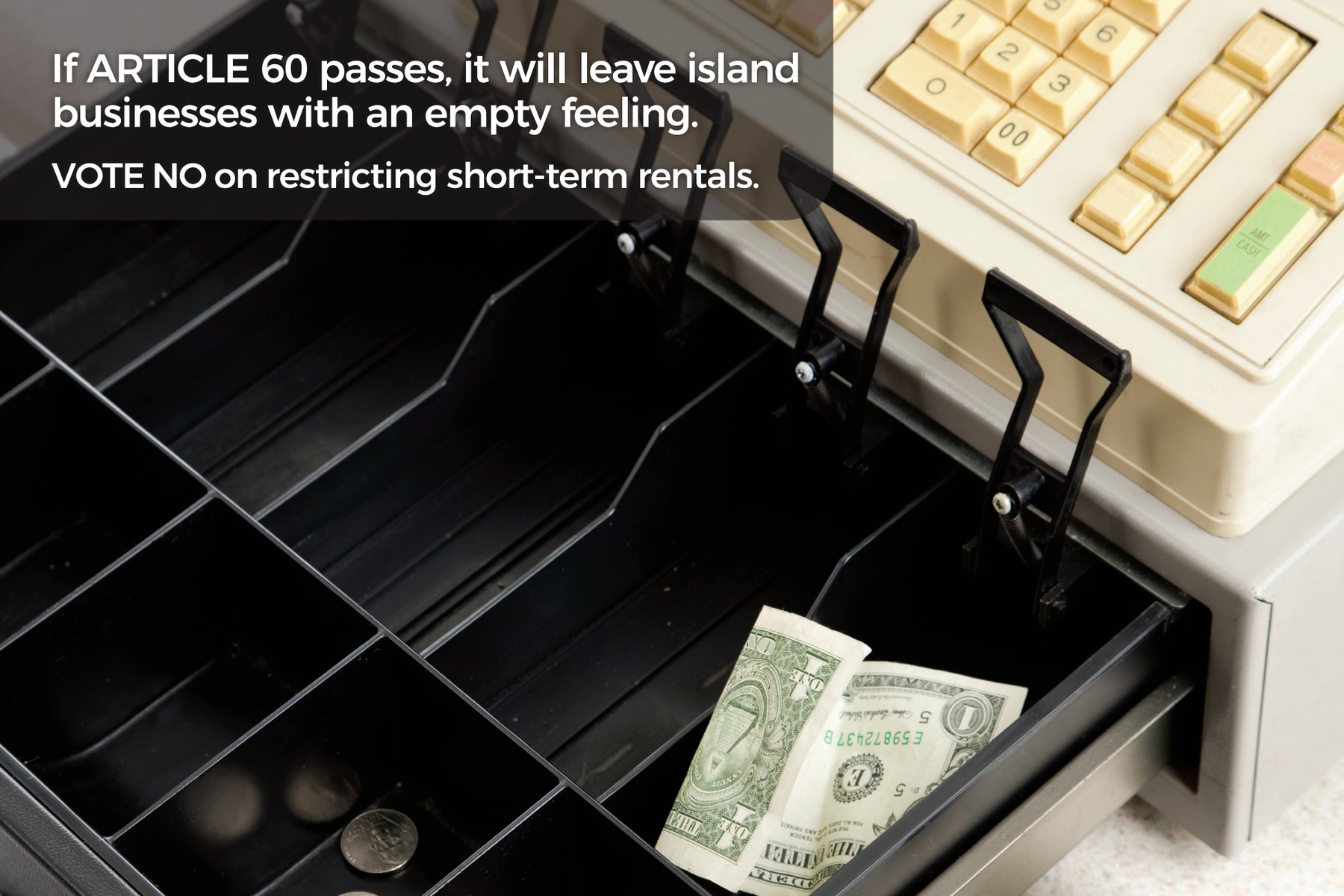
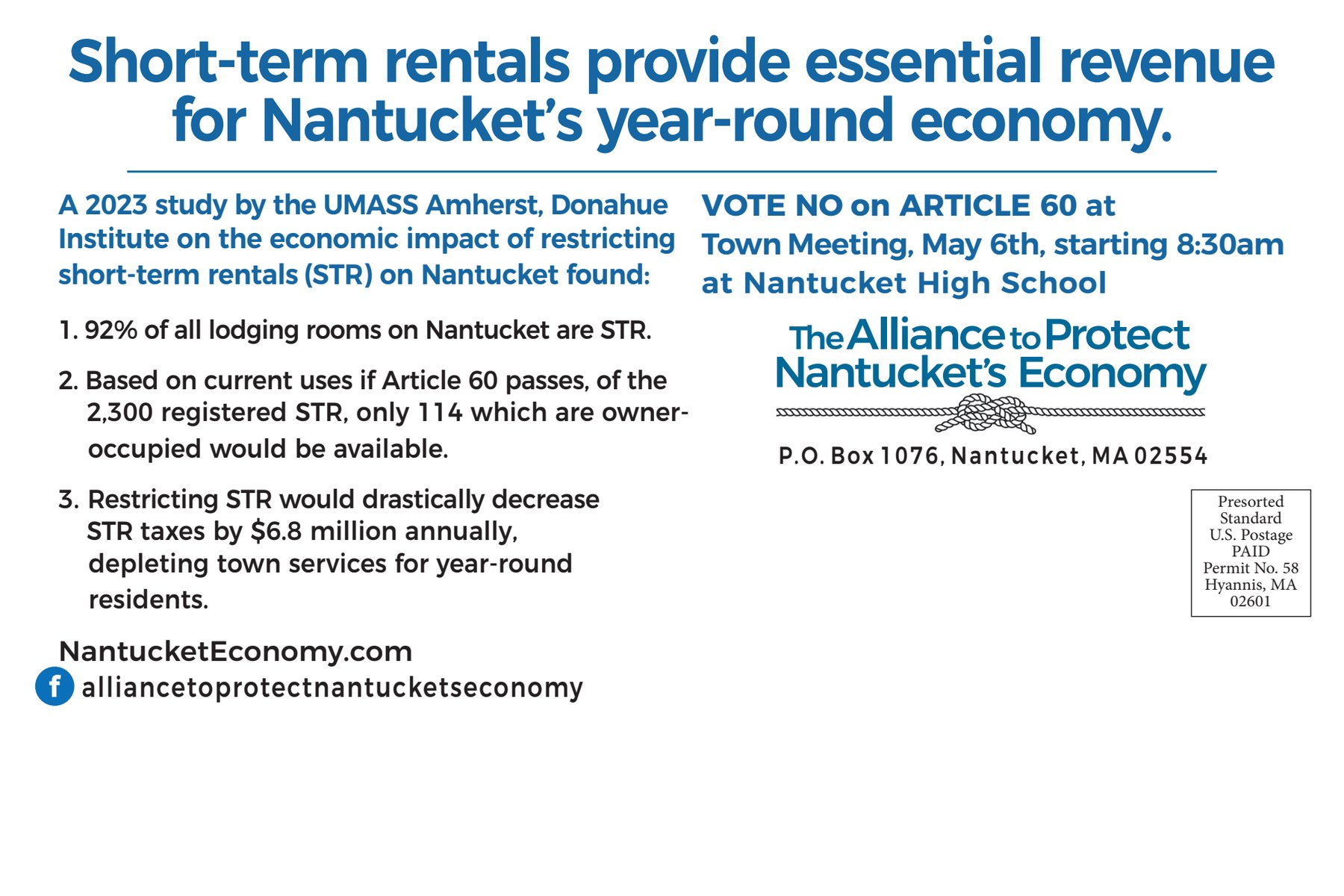
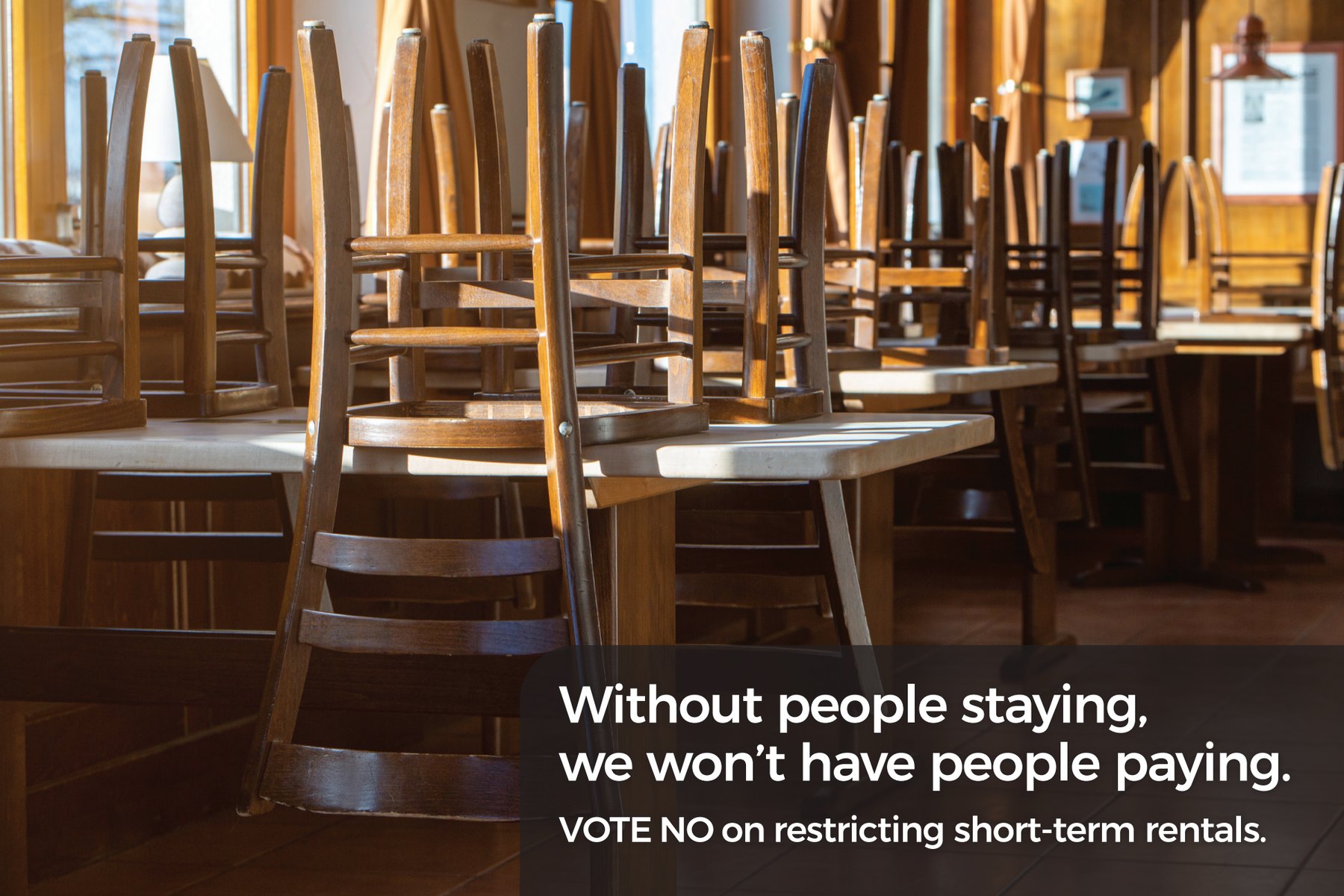
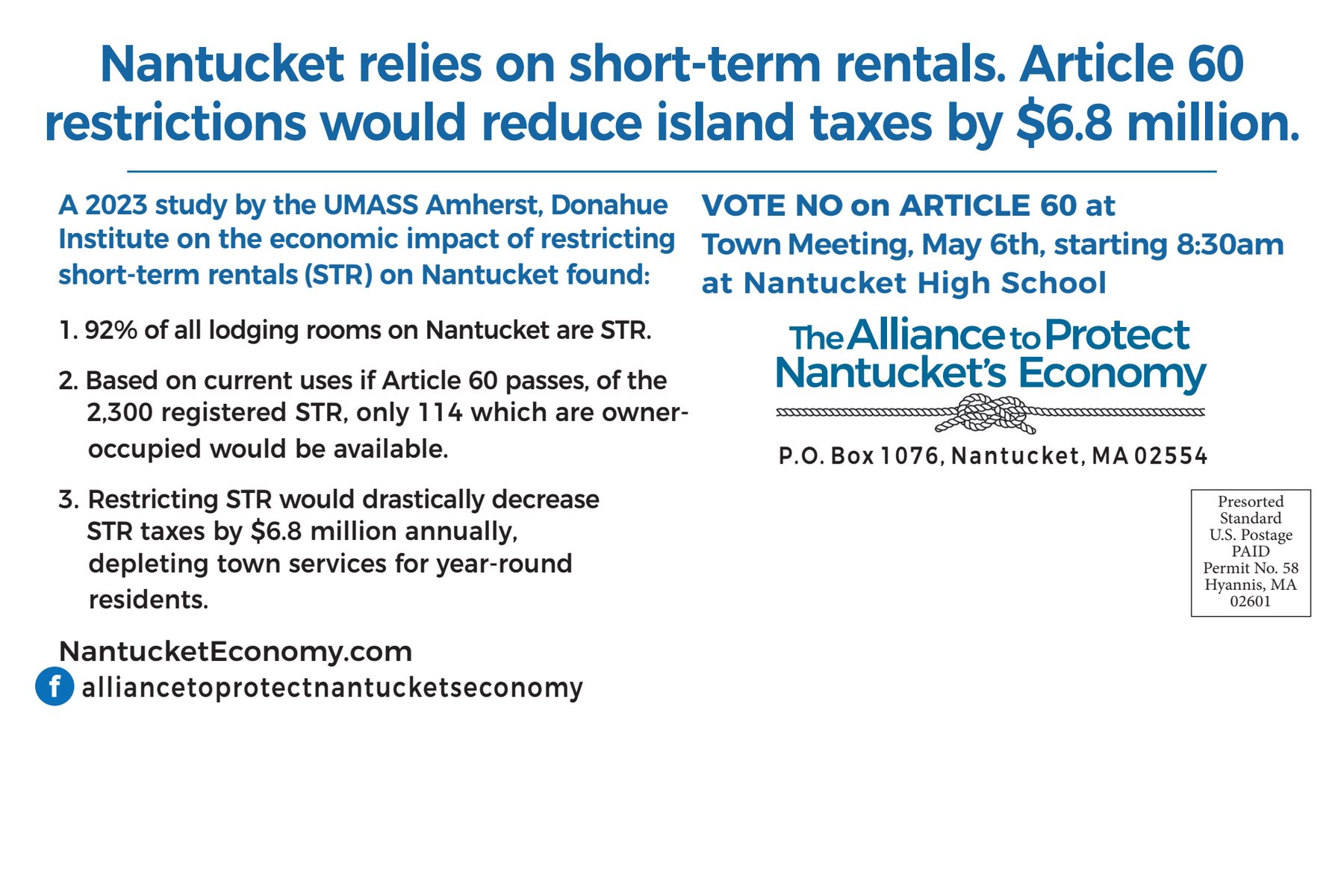
By the third cycle the argument was economic and specific. Both fronts show absence rather than abundance, and both backs lead with the 2023 UMass Amherst Donahue Institute figures: 92% of lodging rooms, 2,300 registered rentals reduced to 114, $6.8 million in lost tax revenue.

  • Mailer front: an open cash register drawer holding only two dollar bills and a few coins.
    Front Empty drawer A nearly empty till. “It will leave island businesses with an empty feeling.”
  • Mailer back: 2023 UMass Amherst Donahue Institute findings on restricting short-term rentals, with Town Meeting details for Article 60.
    Back Essential revenue Three cited findings, framed around year-round town services rather than rentals.
  • Mailer front: chairs stacked on tables in a closed restaurant dining room.
    Front Chairs up A closed dining room. “Without people staying, we won’t have people paying.”
  • Mailer back: headline stating Article 60 restrictions would reduce island taxes by 6.8 million dollars, with study findings.
    Back The number in the headline Final iteration promotes $6.8 million from a bullet point into the headline itself.

All six pieces were mailed at Presorted Standard, Permit #58, Hyannis MA. View the full production PDF